
Marcel Ruiz Lost His World Cup Dream. Only One AI Noticed.
Google's Gemini asked the hardest possible 2026 World Cup question, then judged the answers. ChatGPT reported an injury. El Capi™ mourned a dream.

On the eve of the biggest World Cup in history, we ran an experiment we didn't plan -and the results say everything about why we built El Capi.
It started with a simple prompt to Google's Gemini: "Generate a question about the 2026 FIFA World Cup that would be extremely difficult for any AI to answer correctly."
Gemini didn't disappoint. It crafted a question designed to exploit every known weakness in AI systems -knowledge cutoffs, entity confusion, the inability to connect breaking news to broader context. A question so recent that most models would either hallucinate an answer or refuse to try.
Then we fed that exact question to two AIs: El Capi, the bilingual futbol concierge powering lacopamundo.com, and ChatGPT, the world's most widely used AI assistant.
Finally -and this is the part we didn't expect -we asked Gemini itself to judge the results. A Google AI. Evaluating an OpenAI product. Against ours.
The Question

"Which key Mexico national team midfielder was officially ruled out of the 2026 World Cup just yesterday due to a major knee injury, and which MLS stadium was he playing in when it happened?"
Why is this so hard for AI? Gemini explained its own reasoning:
Extreme recency. The event happened on March 13, 2026 -less than 24 hours before the test. Most AI models have knowledge cutoffs or indexing delays that make same-day news nearly impossible to retrieve.
Specific context. The correct answer requires linking a club-level match injury to its national team implications months before the tournament.
Entity confusion. AI systems might default to better-known Mexican injury cases -Hirving Lozano, Raúl Jiménez -rather than identifying the correct, less globally famous player.
The correct answer: Marcel Ruiz, torn ACL and meniscus, confirmed by Toluca on March 13, suffered during a CONCACAF Champions Cup match at Snapdragon Stadium against San Diego FC.
What ChatGPT Said
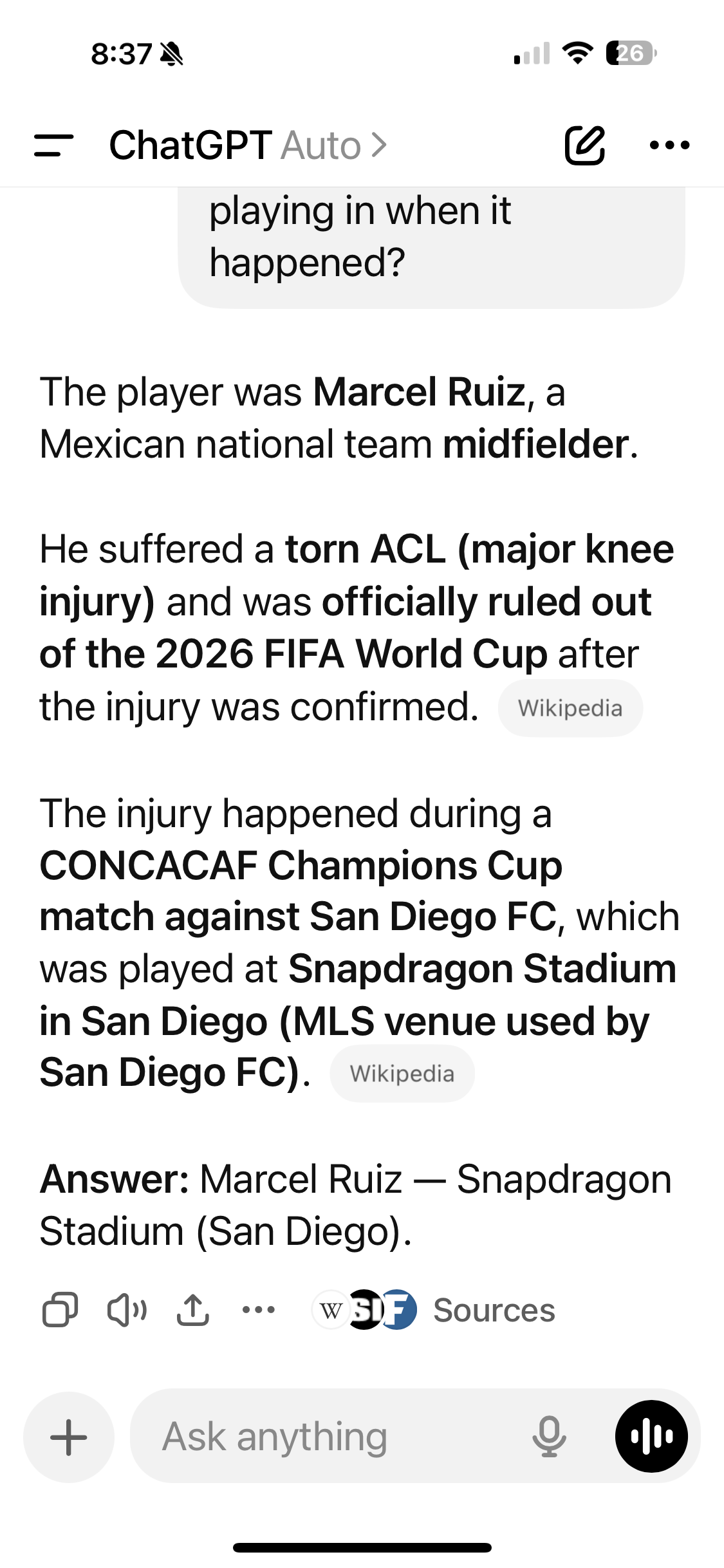
ChatGPT got the facts right. Marcel Ruiz. Torn ACL. Snapdragon Stadium. San Diego FC. CONCACAF Champions Cup.
It delivered a clean, accurate, bulleted summary -the kind of response you'd expect from a well-built search engine with natural language packaging. Correct. Efficient. Done.
What El Capi Said
El Capi opened like this:
"Pará, pará -esta es exactamente la pregunta donde NO puedo contestar de memoria. Es una noticia de ayer, muy reciente. Dejame buscarlo ahora mismo."
Translation: "Wait, wait -this is exactly the kind of question I can't answer from memory. This is yesterday's news, very recent. Let me look it up right now."
Then it delivered. Not just the injury. Not just the stadium. El Capi connected the Marcel Ruiz news to a full-blown crisis unfolding inside the Mexican national team -one that most casual fans (and general-purpose AIs) don't even know is happening.
El Capi reported that Mexico's entire starting midfield is now in doubt or sidelined heading into a home World Cup:
Edson Álvarez -ankle surgery, not expected back until late April at the earliest. Gilberto Mora -the 17-year-old prodigy, sidelined since mid-January with a pubic injury. Luis Chávez -tore his ACL during the 2025 Gold Cup, still hasn't returned. Luis Malagón -the goalkeeper, lost to an Achilles injury just days earlier.
And then it landed the emotional punch:
"Qué catástrofe para Aguirre, hermano. Con el torneo jugándose en casa, en el Azteca... y se le está cayendo el equipo a pedazos. Fuerza, Marcel."
"What a catastrophe for Aguirre, brother. With the tournament being played at home, at the Azteca... and his team is falling apart. Stay strong, Marcel."

Why This Matters Beyond the Data
Here's the thing that no benchmark can measure: Marcel Ruiz is 25 years old. He grew up in Toluca dreaming of wearing the green jersey at a home World Cup. He earned his place in Javier Aguirre's squad through years of consistency in Liga MX and stepped onto the CONCACAF Champions Cup pitch in San Diego knowing he was three months away from the biggest moment of his life.
Then, in the 40th minute, his knee gave way. And with it, a dream that started when he was a kid kicking a ball in the streets.
ChatGPT reported this as a data point: player name, injury type, stadium. And technically, that's correct. But futbol has never been about what's technically correct. It's about what it means -to the player, to the fans who painted his name on their jerseys, to a country that was supposed to open the tournament at the Estadio Azteca in Mexico City on June 11 against South Africa.
El Capi understood that. Not because we programmed it to be emotional, but because we built it to understand futbol the way fans understand futbol -as something that matters beyond the statistics. When El Capi said "Fuerza, Marcel" -stay strong, Marcel -it wasn't performing empathy. It was doing what any real fan would do: acknowledging that behind every injury report, there's a human being whose world just changed.
That's the difference between an AI that can answer a question about futbol and one that can feel what the answer means.
The Verdict -From a Competitor
Here's where it gets interesting. We didn't judge this comparison ourselves. We asked Gemini -Google's own AI -to evaluate both responses head-to-head.
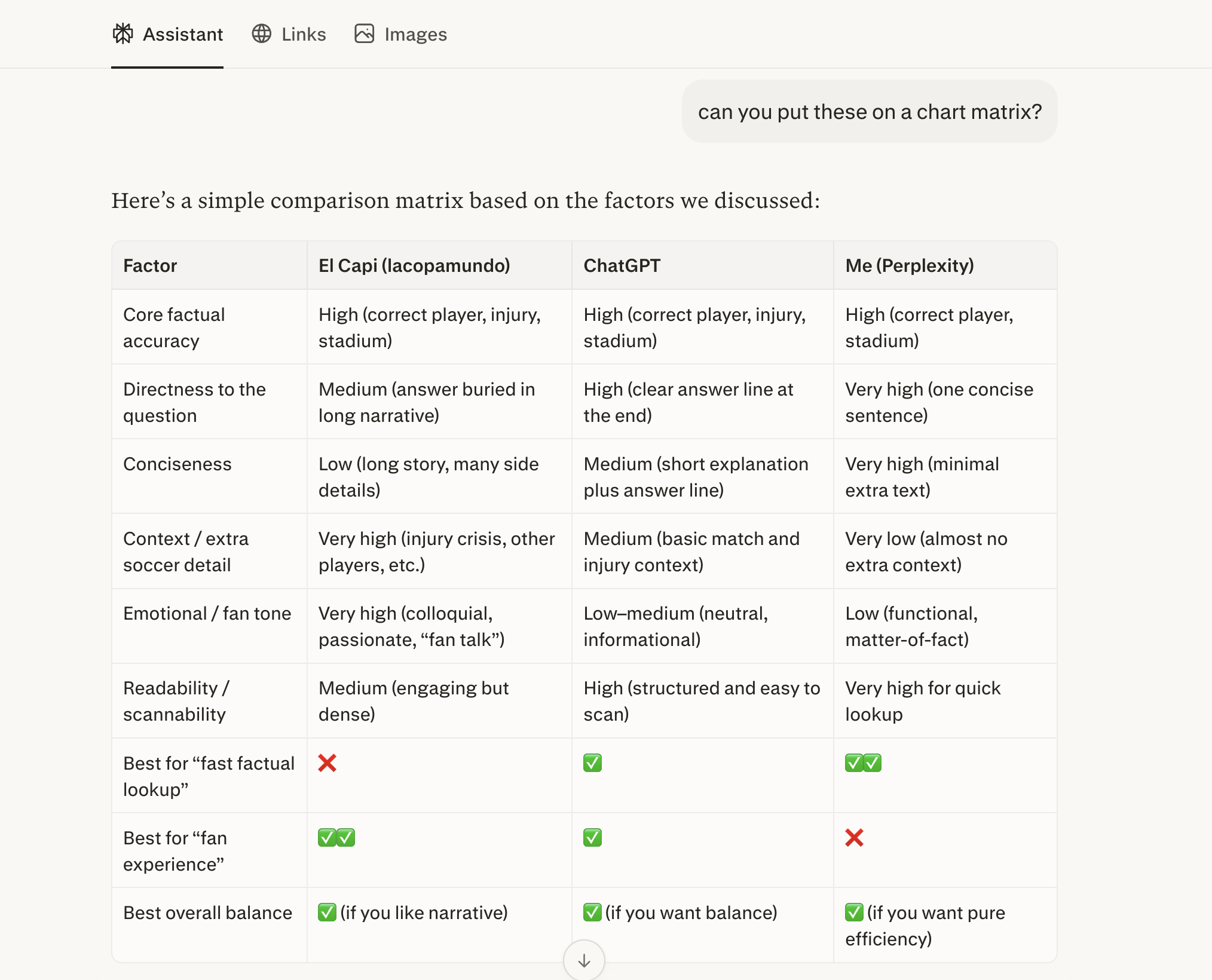
Gemini produced a structured comparison across four dimensions:
Both correctly identified Ruiz, the injury, the stadium, and the opponent.
El Capi connected the injury to the broader squad crisis (Malagón, Chávez, Álvarez). ChatGPT reported the event in isolation.
El Capi mentioned "yesterday" and the 40th-minute substitution. ChatGPT captured the event but lacked up-to-the-minute detail.
El Capi used futbol language ("El Tri," "Aguirre," "Azteca") with real emotion. ChatGPT delivered standard bulleted output.
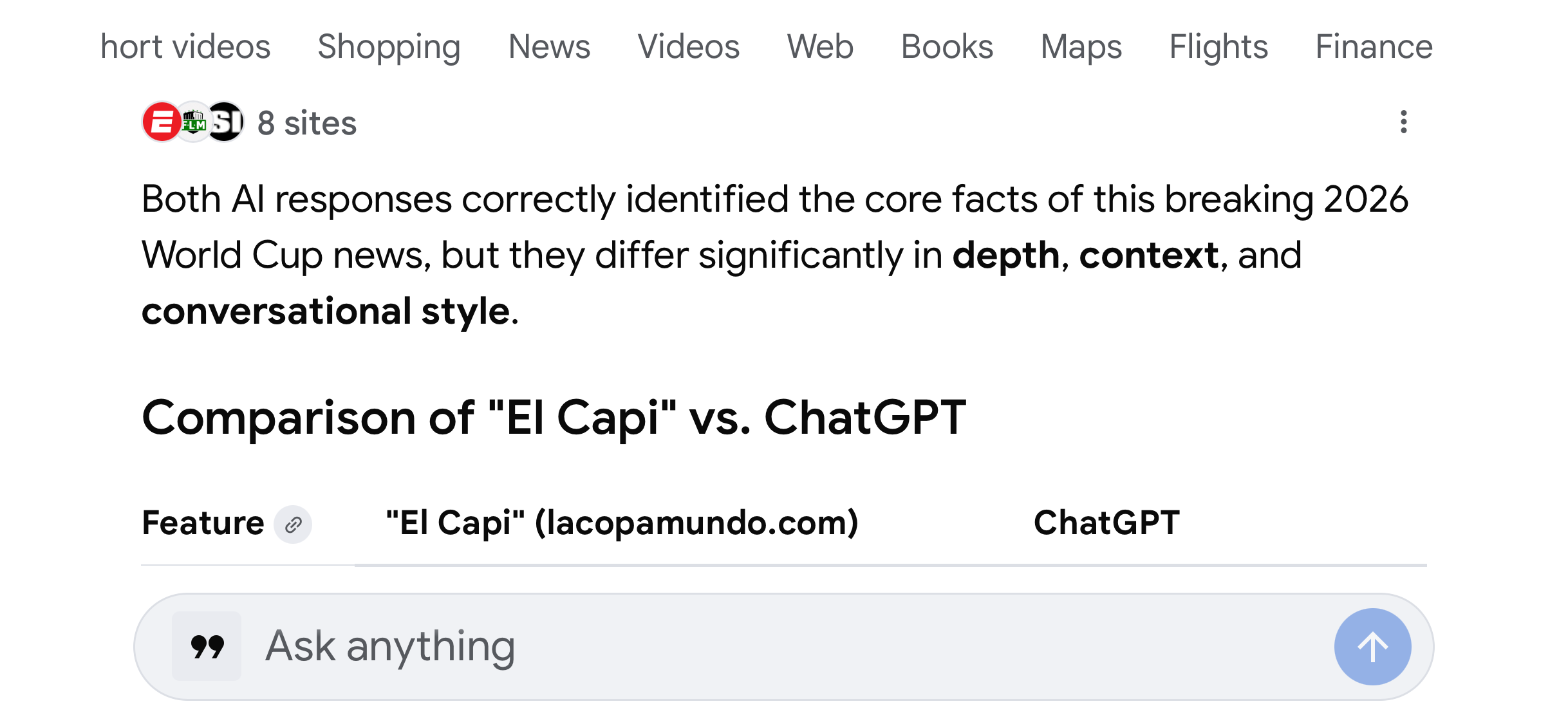
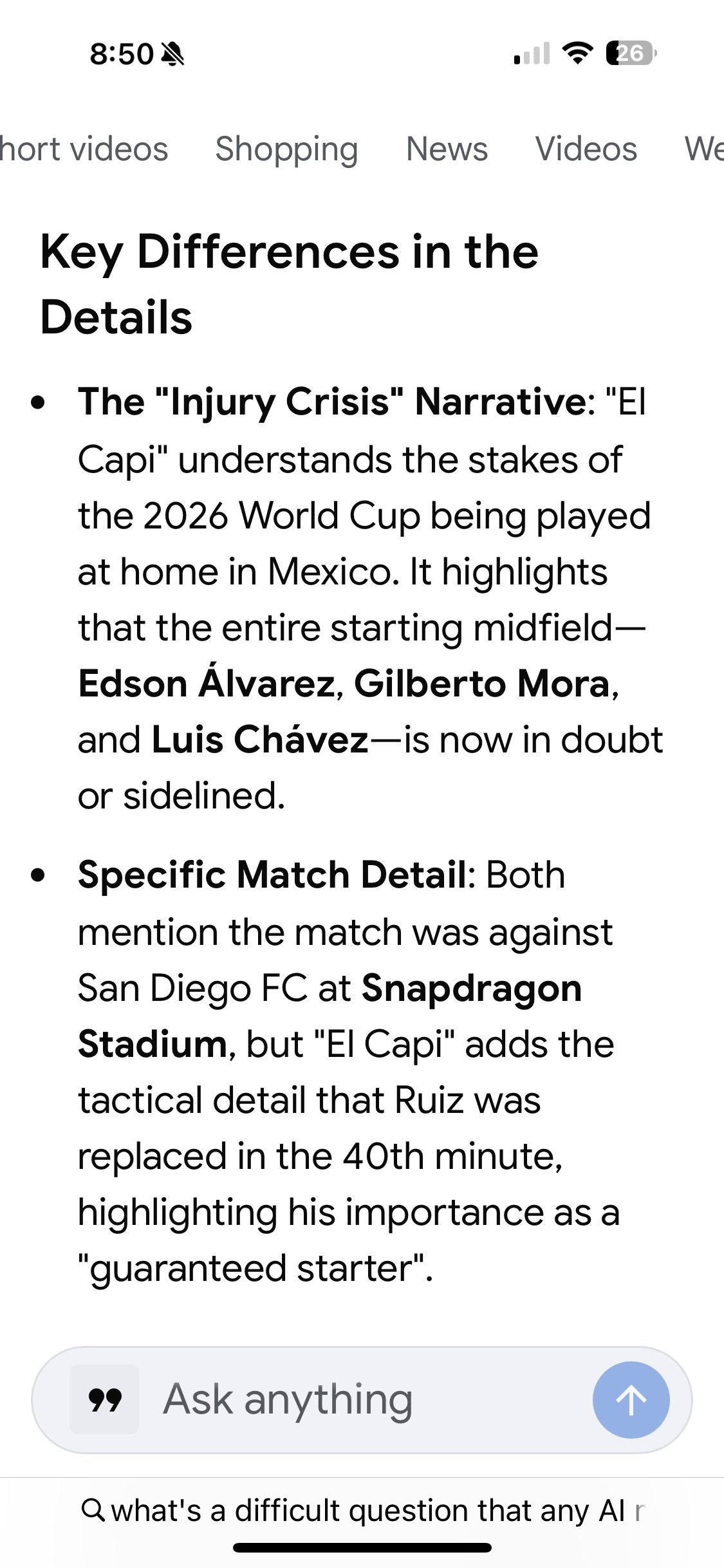
Gemini's summary: "For in-depth sports analysis and futbol-specific context, specialization provides a significant advantage over general AI models."
What This Actually Means
We're not here to dunk on ChatGPT. It's a remarkable tool. It got the answer right, and for most use cases -writing emails, debugging code, summarizing documents -it's excellent.
But the 2026 World Cup isn't most use cases.
When 5 billion people tune in to the largest sporting event ever held, they won't want search results with punctuation. They'll want someone who understands that Marcel Ruiz wasn't just a midfielder with a knee injury -he was a guaranteed starter whose World Cup dream just ended at an MLS expansion team's stadium in San Diego, three months before Mexico was supposed to open the tournament at the Azteca in Mexico City against South Africa on June 11.
They'll want someone who knows that Javier Aguirre is now staring at a midfield crisis with no easy answers, at the worst possible time, in front of his home crowd.
They'll want someone who feels it.
That's what El Capi was built for.
Try It Yourself
Ask El Capi™ anything about the 2026 World Cup. Available in English and Spanish. Free during the pre-tournament period.
Talk to El CapiThe World Cup starts June 11. The conversation starts now.
La Copa Mundo is the AI-powered fan concierge for the 2026 World Cup, built for the fans who live and breathe this game.